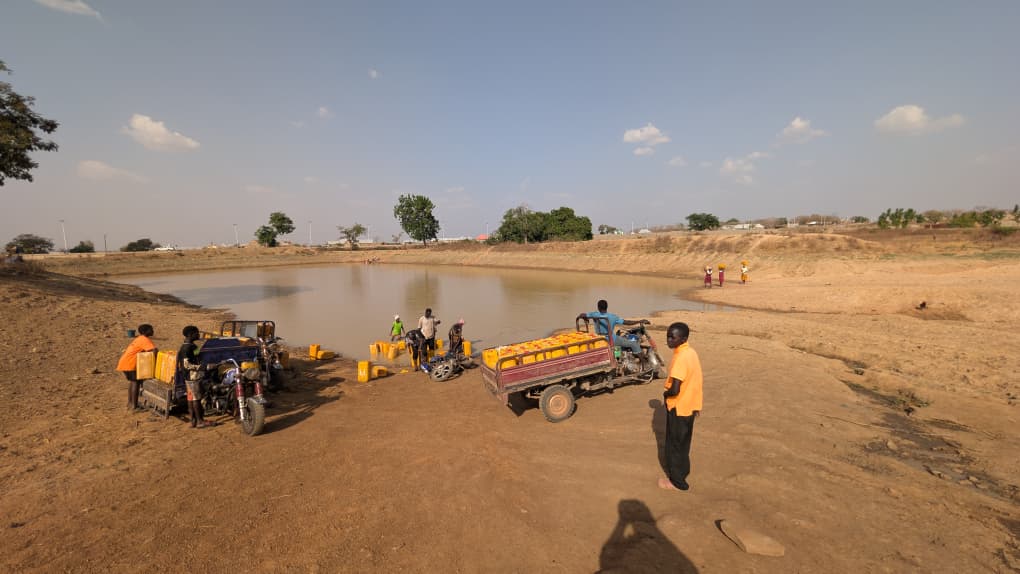
Before the school day begins, children in Nanton Zuo are already on their way to the dam with containers to fill. They carry the water home for cooking, washing and drinking. In some households, the morning trip comes before the journey to school. The same source serves several needs in the home, so a family cannot avoid it simply by deciding not to drink from it. Water is needed to prepare food, clean utensils and get through the day. When there is no dependable alternative, even residents who worry about the dam’s condition must keep returning.
For Zubaidu Hazifa, a student at Anbariya Senior High School, collecting water from the dam is part of everyday life. “We use it for every purpose. My parents, siblings, and I all drink and cook with it,” she said.
The water is brown. Residents say rain washes dirt and human waste into the dam. Discarded nappies and other rubbish can reach the water, and cattle, goats and dogs also use the source. Memunatu, a resident, said: “When it rains, dirt and human waste enter the dam.” Asked why people still use it, she replied: “We have no alternative.”
Nanton Zuo, in Ghana’s Northern Region, has spent years searching for a dependable source of water. Boreholes have failed or produced water residents say they cannot readily use. Pipes have been connected, but residents say water does not flow reliably. A regional project remains a possible source of relief. For now, families continue to draw water from the dam because they need water every day. The shortage follows them from one part of life to another, into the kitchen, the school timetable and the household budget. The options residents describe are not available. A source that is difficult to reach, too salty for common uses or unsafe to drink does not solve the need for a reliable supply.
In 2025, I collected a sample from the dam and submitted it to the Ghana Water Company’s Regional Quality Assurance Department in the Northern Region. The sample failed regulatory standards for physical and chemical parameters. The laboratory recorded microbial contamination as “TNT” — too numerous to count.
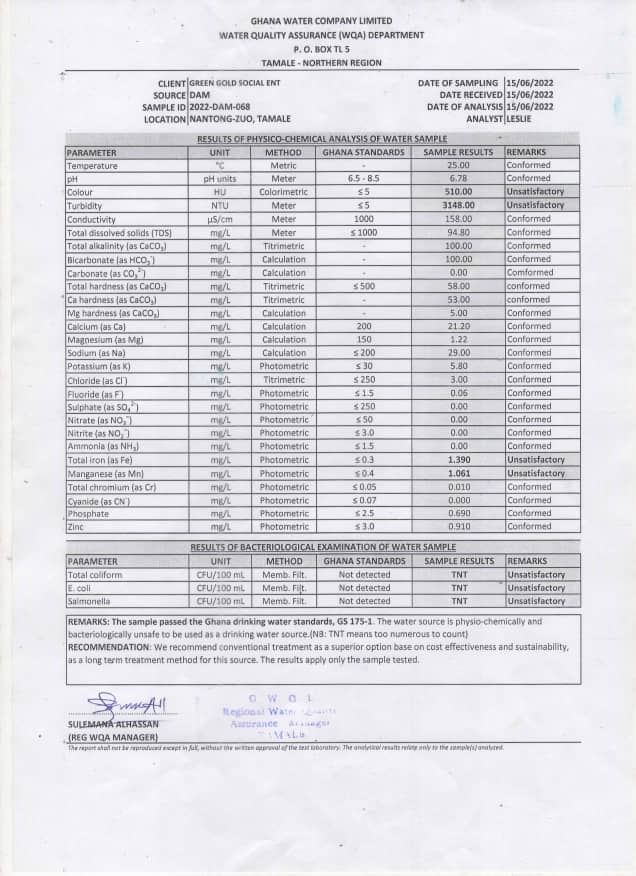
More than a year after the result was published, residents still lacked a dependable alternative capable of meeting their needs.
The test behind the warning
Sulemana Alhassan, then the Northern Regional Water Quality Assurance Manager, said the water’s appearance raised concern, but sight alone could not establish its safety. Laboratory analysis, he said, was needed to measure what was in the water and provide evidence that could guide a response.
“Instinctively, when you see it, you know that it’s not potable,” Alhassan said. “The best thing is to analyze it and turn this water into data,” he added.
Alhassan said the sample failed Ghana’s physical and chemical requirements. The microbial count was too high for the laboratory to count. He warned that drinking untreated water over time could cause harm, although the timing and severity of illness would vary from person to person.
Consultant urologist Dr Akis Afoko, who reviewed the findings at the Tamale Urology and Modern Surgical Centre, said the report indicated high levels of Salmonella and E. coli. Salmonella can cause typhoid fever, while E. coli can indicate contamination by human or animal waste.
Afoko said his centre had treated residents, including children, for severe diarrhoea and other illnesses. He also described serious complications associated with typhoid, including cases in which damage to the bowel had become life-threatening.
Afoko said the findings were worrying. Residents of Nanton Zuo, however, continue to depend on the dam for their daily water needs.
A family’s attempt to follow medical advice
For the Zakaria family, the question of water became urgent during the final illness of 75-year-old Fuseini Zakaria. He died at home in Nanton Zuo on 23 February 2022 after being diagnosed with kidney failure at Tamale Teaching Hospital.
His eldest son, Yakubu Zakaria, said doctors advised the family not to give his father water from the dam. They were told to use bottled water, including Voltic. Following that advice meant finding extra money for drinking water while the family was already dealing with illness and hospital visits.
Yakubu believes a water-borne infection contributed to his father’s condition. “They carried on tests upon tests and concluded it was water-borne disease that led to the kidney failure,” he recalled.
Their account highlights the challenge of following such advice when safe drinking water must be bought and the family has limited means.
The experience is not unique in its financial consequences. Afa Sulley, whose household has six people, estimated that sachet water for the family could cost GH¢12 to GH¢18 a day. Over a month, that is about GH¢360 to GH¢540 — money that might otherwise pay for food, transport, school needs or other household expenses.
“If a family of six needs GH¢12 to GH¢18 a day for sachet water, how can we manage? It is not realistic for us,” Sulley said. “When you drink the water, you pray not to fall sick. When you buy clean water, you go hungry that day,” he told this reporter.
For families relying largely on subsistence farming, buying safe water competes with other expenses. Some may buy it for drinking but continue to use dam water for cooking or washing. Others may buy less than they need. The options depend on how much money is available that day.
Sachet water is sold in small quantities, but the daily cost builds up over weeks. The choice can be especially difficult when income depends on seasonal work or what a household can produce and sell. A family may understand the advice to avoid unsafe water and still be unable to follow it consistently.
Yakubu Habiba said she spent about GH¢600 on hospital care, including infusions and medicines. She said a doctor told her the water had caused her illness. Describing why she continued to use the dam despite her concerns, she said: “Yes, if I don’t stop drinking the water, then it is because I have no option. But if I have a way, I will stop because I know the water is not good for my health.”
Her words reflect the dilemma facing residents who depend on the dam but have few affordable alternatives. For Habiba, avoiding the water is not simply a matter of choice; it depends on whether she can find another source.
The hours taken from children and women
Water collection also takes hours. During the dry season, residents say, women and girls may walk three to five kilometres and spend two to three hours fetching it. That time comes out of the day’s farming, housework, rest and schoolwork. The distance and time can vary with conditions, but residents describe the task as a regular part of household life. Water must be collected again as it is used, leaving little room for a day when someone is ill, a child has an examination or farm work needs attention.
Northern Regional Manager of the African Methodist Episcopal Zion Church, Ransford Kwabena Bayisi, said the shortage affects attendance at the AME Zion Primary School in Nanton Zuo. “Some days, nearly half of the children in a class stay home — they are sick, or they have gone to look for water,” he said. When pupils miss lessons, teachers sometimes have to repeat work before the class can move forward.
Some pupils miss school because they are ill; others are sent to fetch water. A child who spends the morning on the trip may arrive late or miss lessons. A child recovering from illness may find it hard to catch up. Teachers then have to deal with the effects of a water shortage they cannot fix themselves.
Girls may lose valuable study time when they are expected to help their families fetch water. Residents described long hours spent walking to the dam, waiting to collect water and carrying it home. Although a community-wide attendance survey was not conducted, Bayisi’s account offers a glimpse of how water shortages affect children’s schooling.
The shortage also shapes access to healthcare. Residents often travel 10 to 15 kilometres to reach public health facilities, including Tamale Teaching Hospital. The Tamale Urology and Modern Surgical Centre offers specialised care; it is not a substitute for a public facility treating everyday illnesses. Residents described self-medication and delaying treatment until symptoms became more serious.
Why the boreholes have not solved it
Residents and organisations have made repeated attempts to find groundwater in Nanton Zuo, but the number of failed boreholes varies across accounts. A November 2025 JoyNews follow-up reported that residents put the number at more than 15. Abdullah, a community resident who recalls these efforts dating back to his childhood, estimates that about 20 boreholes have been attempted in the area.
“They drill and there is no water,” Abdullah said.
Water resources development engineer Fadlu Rahman Mashod said the local geology helps explain the repeated failures. The area’s mudstone and shale formations do not readily allow water to enter or be stored in the rock, making groundwater difficult to find.
“There is very little groundwater. Most of the time, when you drill, you won’t find water,” Mashod said. “The rocks here are mudstone and shale. These rocks do not allow water to enter or be stored inside them. It is not only Nanton Zuo. The whole area has this problem.”
Mashod said finding groundwater could require detailed geological studies, specialised equipment and deeper drilling, with no guarantee of success. The issue, he said, is not how many holes are drilled but whether each attempt is guided by enough evidence to make it worthwhile. His explanation also cautions against treating every failed borehole as a lack of effort by residents.
Green Gold Social Enterprise has worked with Nanton Zuo for about six years, helping mobilise support for boreholes through the Grundfos Foundation – pdjf. Yet the efforts have not delivered a dependable water source.
A newer borehole produces water, but residents question its usefulness. Yakubu Suraiya described one everyday difficulty, “The water does not lather with soap,” she said. Another resident, Memunatu was equally worried, “The water is very salty.” She said tea prepared with it was difficult to drink and food cooked with it could become watery by the following day.
The dry pipes
There is another reason residents of Nanton Zuo feel stranded, the community has a piped water network, but the taps remain dry.
A resident, Abdullah, said the pipes had been connected more than five years ago, yet water was still not flowing through them.
“More than five years now, the pipes have been connected, but no water is flowing,” he said.
His account comes against the backdrop of a wider water-supply crisis in Tamale, where demand has outstripped production capacity. A 2025 study published in Cleaner Waste Systems found that only 66 per cent of households surveyed across the Tamale Metropolis were within 500 metres of a water distribution pipeline. Even proximity to the network did not guarantee a dependable supply, with some households reporting interruptions lasting more than two weeks.
The study also highlighted seasonal pressure on water production. During the dry season, from November to March, reduced flows in the Nawuni River at Dalun can limit the volume of water available for treatment and distribution.
The scale of the shortfall was outlined by Albert W. Nyeteng, the Northern Regional Production Manager of Ghana Water Limited (GWL), during a recent engagement with Northern Regional Minister Ali Adolf John. He said Tamale required between 90,000 and 95,000 cubic metres of water daily, but production stood at only 35,000 to 38,000 cubic metres.
Nyeteng also cited emergency repairs to a faulty 700-millimetre transmission pipeline, which had temporarily worsened the shortage.
He said the Tamale water system, established in 1972, had undergone only one major expansion, in 2008. Extending the Yapei Water Project, he said, was a long-term solution expected to improve supply to Tamale and surrounding communities.
Plans for another major expansion of the Tamale water system were announced in July 2020, when then President Nana Addo Dankwa Akufo-Addo cut the sod for a project valued at US$223,287,979.56. Funded by UK Export Finance and Deutsche Bank AG’s London branch, the facility was expected to produce 29.7 million gallons of water a day.
However, the project had yet to commence six years after the sod-cutting ceremony..
Returning to the dam — with a different plan
After repeated difficulties with groundwater, Green Gold Social Enterprise is looking again at the dam. Its executive director, Clement Matorwmasen, said the current approach is to rehabilitate the existing source rather than rely only on more drilling.
“The approach now is to rehabilitate the dam,” he said.
The proposed work includes dredging accumulated sediment, strengthening the banks, fencing the area to keep animals out and reducing waste entering the water. Matorwmasen estimates the dam currently holds about two million litres and that rehabilitation could increase its capacity to around six million litres. The aim is to retain more water, especially during the dry season, when the pressure on the source becomes more acute.
Population growth has added to that pressure. Dokurugu Abukari said the community’s population had increased, putting greater demand on the dam. While Feruza Mohammed added that, people from neighbouring communities also come to collect water when their own sources dry up. Matorwmasen said the dam attracts people from beyond Nanton Zuo, including some from Tamale. A source already struggling to meet the community’s needs is therefore serving a wider population.
Matorwmasen wants the proposed work to become a model for community-based water management. “Nanton Zuo can become a living case study,” he said, describing an approach in which communities outside the national water network can harvest, treat, protect and manage their own water resources in ways suited to local conditions.
Rehabilitating the dam could improve its condition, but it would not by itself make the water safe. Dredging may remove sediment, fencing may keep animals away from the edge, and bank protection may reduce erosion. None of those measures alone proves that harmful microorganisms or chemical contaminants have been removed.
Alhassan said conventional treatment can remove suspended matter, colour and dangerous microorganisms. Depending on the water’s characteristics, pH adjustment may also be needed. After treatment, the water must be tested to determine whether the process has worked and whether harmful contaminants remain.
Before work begins, Alhassan stated that the water needs a full assessment so any treatment system is designed for the contaminants present and testing should continue after construction. Residents also need to know who will run the system, pay for treatment materials, maintain equipment and make test results public. Without those arrangements, the dam could be improved physically while questions about safety remain.
Identified other options, including a treatment plant for the existing source, deeper high-yield boreholes informed by geological mapping and hydro-surveys, and affordable ways to test water regularly. Experts say a portable microbial test kit could help detect some microbial risks and track changes, but it would not replace a full assessment, especially where chemical contamination is possible. They said testing is useful only when the results lead to decisions about treatment and when residents can see what the results mean.
A regional promise and a community’s patience
For Nanton Zuo, the promise of a larger water project offers hope, but not an immediate solution. Residents want the community to benefit from the planned expansion and are waiting to see whether it will finally bring dependable water within their reach.
Feruza Mohammed said the project must deliver on its promise. “We know the dam can’t help us now, but only a major project like this can secure our future. It must not become another broken promise.”
Her concern reflects the uncertainty facing a community that has waited years for a reliable water supply. The larger project is intended to serve communities beyond Tamale itself, but its eventual reach will matter little to residents if their own needs are not addressed.
For now, households must continue finding water for drinking, cooking and other daily needs, often at a cost they struggle to afford. Children remain involved in fetching water, while families face the difficult choice between paying for alternatives and spending money on other essentials.
Nanton Zuo’s immediate need, therefore, cannot rest entirely on a project whose benefits have yet to reach the community. Alongside the long-term expansion, residents need a clear commitment on whether and when the existing network can supply them, as well as an affordable and dependable source of safe water while they wait.
The local water-watch group and the limits of self-help
Residents have also tried to reduce risks themselves. They formed a nine-member volunteer water-watch group to discourage dumping and promote safer household practices. Some families strain water through cloth or boil it. Experts said proper boiling can reduce microbial risks, but cloth straining does not reliably remove dangerous microorganisms, and neither method can be relied on to remove chemical pollutants.
The volunteers can discourage dumping and share information, but they cannot guarantee the dam’s safety or build and operate a treatment plant. Their efforts show that residents are trying to protect the source. They cannot replace the work and resources needed from the bodies responsible for water provision.
Authorities contacted declined to comment. But residents have called for urgent support. Community leader Fuseini Salifu said, “What we need is not sympathy; we need action. Our people are dying slowly because we are not a priority.” Zakaria Fati, an elderly resident, put the wish at the centre of the issue: “We don’t want to suffer like this anymore. We just want clean water. We want to live.”
The value of any plan will be clear in everyday life, whether children can drink the water without fear, whether families can afford enough of it, and whether the service continues to work after construction is complete.
What a safe supply would require
Nanton Zuo needs a plan that turns the failed test result into a reliable supply. One immediate step would be to explore whether treated water can be delivered at a price households can afford while a longer-term solution is developed.
If the dam is to remain part of the answer, its rehabilitation must be tied to an assessment of water quality, treatment suited to the findings, protection of the source and a continuing testing programme. The results should be accessible to residents. A failed test should trigger a clear response rather than leave households to interpret the colour or smell of the water themselves. Any borehole proposal should be based on geological evidence and laboratory testing, not drilling alone.
For the Tamale Water Project, residents need an accurate update on construction and a clear account of how Nanton Zuo will be served. However, an interim supply can reduce immediate dependence on the dam while a treated local source or regional connection is developed.
The 2025 test remains the clearest public evidence about the sample collected from the dam: it failed regulatory standards. Residents’ accounts describe the money, time, missed lessons and missed lessons and difficulty reaching healthcare associated with the lack of a dependable supply.