
Farmers in Ghana are being encouraged to adopt efficient irrigation systems, improved planting materials and better crop management techniques to increase vegetable production without necessarily expanding the land under cultivation.
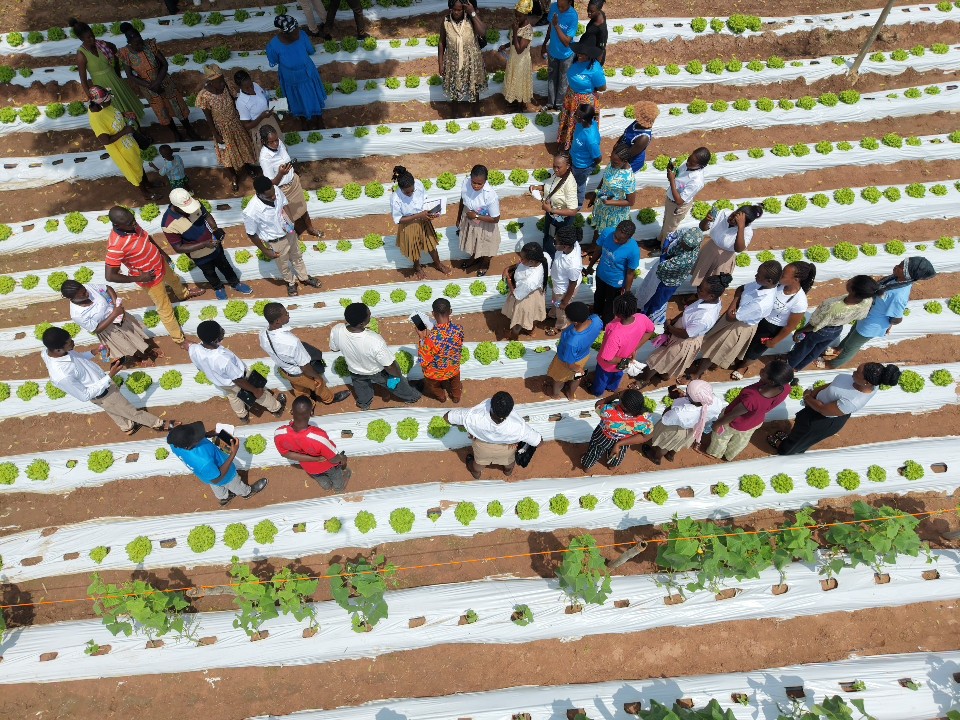
The approach is being promoted under the Agricultural Colleges for Horticulture Innovation (ACHI) Project, which is using demonstration farms and hands-on training to expose farmers and agricultural students to modern horticultural practices.
For Obiri Yeboah Daniel, a farmer from Asante Mampong, the experience at a demonstration farm in Ejura has offered a new perspective on what is possible in agriculture.
Although he had been considering a move into farming, he said he lacked the practical knowledge needed to get started. His visit to the demonstration site introduced him to technologies designed to improve production and make more efficient use of farm resources.
“I have learned a great deal this morning,” he said, recalling his introduction to drip irrigation, sprinklers and plastic mulch, which helps conserve soil moisture and control weeds.
He said he intended to pass the knowledge on to other farmers, particularly members of his cooperative.
“When I return home, I will share what I have learned with others, especially members of my cooperative, and encourage them to adopt these innovative farming practices,” he added.
His experience illustrates the project’s strategy of taking agricultural knowledge beyond theory and allowing farmers to see and practise improved production methods before applying them on their own farms.
Technology and better practices for smallholder farmers
The ACHI Project is a four-year initiative running from 2024 to 2028, with support from the Netherlands Enterprise Agency (RVO). It is implemented by TU Delft and Holland Greentech in partnership with five agricultural colleges in Ghana.
The initiative seeks to strengthen horticultural education while giving students, graduates and farmers the technical and commercial skills required to participate in a more productive agricultural sector.
At the Ejura demonstration farm, participants are introduced to drip irrigation, plastic mulch, hybrid seeds and sticky traps used in integrated pest management.
The technologies are demonstrated on practical plots where trainees can observe their application and learn how different production methods can be combined to improve crop performance.
Programme Manager at Holland Greentech, Deborah Anobil, said the training was intended to prepare participants to apply the techniques independently after leaving the demonstration site.
She explained that combining appropriate technologies with sound agricultural practices could enable farmers to make better use of limited land and improve their earnings.
According to her, efficient irrigation, improved seeds and proper crop management can contribute to higher yields and better-quality vegetables with a longer shelf life.
The approach is particularly relevant to smallholder farmers seeking to increase output without committing additional land to cultivation.
However, the extent to which farmers can benefit will depend partly on the cost and availability of the technologies, as well as their suitability for local conditions. Practical demonstrations allow participants to understand the methods and assess their potential application to their own farming operations.
Agricultural colleges prepare students for business
Beyond improving farm productivity, the project is seeking to make agricultural education more responsive to the realities of commercial farming and entrepreneurship.
At the Ejura College of Agriculture and Mechanisation Centre, students receive practical instruction in irrigation, crop production, harvesting, grading and marketing.
Elizabeth Aboagyewa Amoah, a student and farm manager at the ACHI Garden, said the facility gives learners an opportunity to develop practical skills, including the use of modern irrigation equipment.
“We teach them how to use drip irrigation lines, sprinklers, and other irrigation facilities,” she said.
The training continues after the crops are harvested. Produce from the farm is sorted and graded, while records are maintained and vegetables supplied to markets in Kumasi and other locations.
These activities expose students to the commercial processes involved in running an agricultural enterprise, including quality assurance, production records and market distribution.
The programme also covers business planning, financial management, production costs and marketing. Participants in a four-month training programme are introduced to entrepreneurship and business pitching to help them develop and present viable business ideas.
Deborah Anobil said some graduates had already established businesses in produce aggregation and other segments of the horticultural value chain.
The project is encouraging young people to consider opportunities beyond direct crop production, including storage, logistics, produce aggregation and post-harvest handling.
Such ventures could offer alternative entry points into agriculture for graduates who may not have sufficient land or capital to establish their own farms. They could also help improve the handling and distribution of perishable produce.
Farmer-to-farmer learning expands the project’s reach
The project is extending its training activities to farming communities through demonstration plots, lead farmers and farmer field days.
According to the project, 85 demonstration plots have been established and 115 farmer field days organised, reaching more than 5,000 farmers. More than 900 participants have also received training in improved horticultural production and related skills.
The field days provide opportunities for farmers to observe new techniques, discuss their experiences and determine which practices could work under their particular farming conditions.
For the knowledge gained to produce sustained improvements, however, farmers will need continued access to appropriate equipment, technical support and reliable markets.
The willingness of participants such as Daniel to share their experiences with fellow farmers could help extend the project’s influence beyond the training sites, although wider adoption will also depend on the resources available to individual farmers.
Principal of the Ejura College of Agriculture and Mechanisation Centre, Dr Bright Akoto, said agricultural education must place greater emphasis on practical learning and innovation to address the difficulties confronting farmers.
“Addressing these challenges requires innovation, practical training, and the adoption of modern agricultural practices,” he said.
He identified low productivity, climate variability, post-harvest losses and limited access to improved technologies as some of the major challenges facing the sector.
Through its focus on efficient water use, improved crop production and integrated pest management, the ACHI Project aims to help farmers respond to these challenges while improving the quality and market value of their produce.
Its emphasis on enterprise development also recognises that increased production must be supported by effective storage, transportation and marketing systems if farmers are to translate better harvests into improved incomes.
In the longer term, the initiative aims to position agricultural colleges as centres of practical training, prepare graduates for employment and entrepreneurship, and encourage commercial partnerships and investment between Ghanaian and Dutch businesses.
For farmers and students engaging with the programme, the central test will be whether the skills and technologies demonstrated at Ejura and other project sites can be applied sustainably to build more productive farms and viable agricultural businesses.