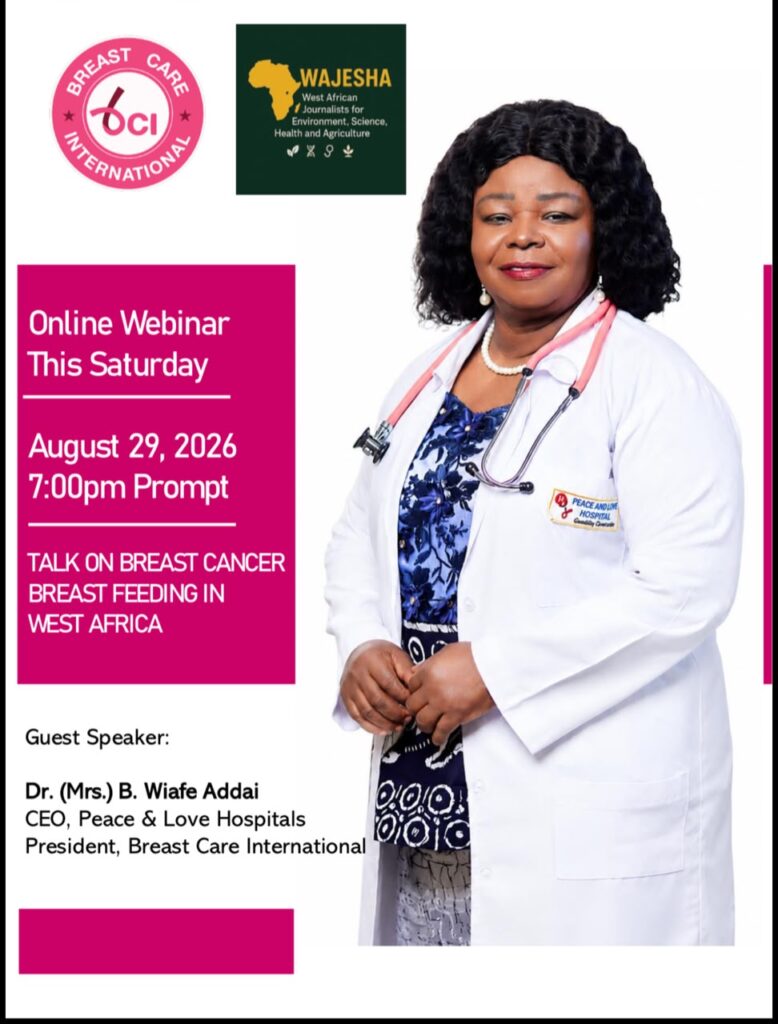
Breastfeeding can reduce a woman’s risk of developing breast cancer, but it does not make her immune to the disease, President of Breast Care International, Dr Beatrice Wiafe Addai, has said.
She has therefore cautioned women against ignoring persistent breast changes during pregnancy or while breastfeeding.
Dr Wiafe Addai made the remarks during a webinar organised by the West African Journalists for Environment, Science, Health and Agriculture (WAJESHA) for journalists across West Africa.
The webinar was held on the theme, “Breast Cancer & Breastfeeding in West Africa: Understanding the Data, Trends, Risks & Best Practices.”
“A breastfeeding woman can still develop breast cancer,” she told participants, stressing that persistent lumps and other suspicious breast changes must be assessed promptly.
According to her, one of the major challenges in the fight against breast cancer in West Africa is late presentation, with many women delaying medical attention because of cost, distance, misinformation and limited access to diagnostic and treatment services.
Breast cancer remains the leading cancer affecting women in Ghana.
IARC/WHO GLOBOCAN 2022 estimates presented during the webinar showed that Ghana recorded an estimated 5,026 new breast cancer cases in 2022, with about 2,491 deaths.
Across Western Africa, the presentation estimated 41.6 new breast cancer cases and 22.3 deaths for every 100,000 women.
Lower risk, but not complete protection
Dr Wiafe Addai explained that while breastfeeding is associated with a reduction in breast cancer risk, women must understand that the protection is not absolute.
Evidence reviewed by the International Agency for Research on Cancer suggests that the risk may reduce by about two per cent for every additional five months of breastfeeding over a woman’s lifetime.
Another estimate cited during the presentation indicated a reduction of about four per cent for every 12 months of cumulative breastfeeding.
The possible protective effect is linked to changes in hormone exposure and breast tissue during pregnancy and lactation.
However, Dr Wiafe Addai said women should not interpret the benefits of breastfeeding to mean they cannot develop breast cancer.
“Breastfeeding lowers risk; it does not eliminate it,” she said.
She explained that women who are pregnant, breastfeeding or have recently given birth can still develop the disease.
Changes associated with pregnancy and breastfeeding, including breast density, engorgement, nodularity, mastitis and milk-filled cysts, can also make it difficult to identify a suspicious lump.
For that reason, she said, women should not automatically assume that every persistent breast change is caused by milk production, a blocked duct or mastitis.
A lump in the breast or armpit, unusual nipple discharge, dimpling of the skin, nipple retraction, an ulcer or noticeable changes in the size or shape of the breast should be assessed by a health professional.
Women should not wait until breastfeeding ends
Dr Wiafe Addai said breastfeeding mothers should not be asked to wait until they stop breastfeeding before suspicious breast symptoms are investigated.
She said ultrasound is often the first imaging test used to assess a breast lump during pregnancy or lactation, while mammography can also be used where clinically necessary.
Breastfeeding, she stressed, should not prevent a woman from undergoing necessary diagnostic tests.
Where required, a biopsy can also be performed to establish a diagnosis.
She dismissed the belief that a biopsy causes cancer to spread, describing it as one of the misconceptions that can delay treatment.
Other myths surrounding breast cancer include beliefs that the disease is caused by witchcraft or evil spirits, that it is a curse, that it cannot be treated, or that women die because they undergo mastectomy.
Dr Wiafe Addai urged journalists to handle such issues responsibly.
She said the media should report on cultural beliefs and misconceptions without ridiculing patients and their families, while ensuring that the public receives accurate information about breast cancer and the importance of early treatment.
Beyond awareness campaigns
The Breast Care International President also challenged journalists to go beyond awareness campaigns and examine the difficulties women face in accessing care.
She said journalists should investigate what happens after a woman notices a suspicious breast change.
Questions, she said, should be asked about whether diagnostic services are affordable, how far women must travel to access specialist care, whether pathology services are available and how long patients wait for results.
Access to surgery, chemotherapy, radiotherapy and essential medicines must also be part of the conversation, she added.
For breastfeeding mothers, the discussion should also include whether they are assessed promptly and whether proper infant-feeding counselling is available alongside cancer treatment.
Late presentation, Dr Wiafe Addai noted, remains one of the biggest challenges affecting breast cancer outcomes in the region.
Women may delay seeking medical help because they lack information, fear stigma, cannot afford tests and treatment or live far from specialist health facilities.
Treatment and breastfeeding decisions
Dr Wiafe Addai said decisions about treatment and breastfeeding must be made based on the individual circumstances of each woman.
The type and stage of cancer, as well as the treatment required, can determine whether breastfeeding can continue.
Surgery, chemotherapy, radiotherapy, hormonal treatment and targeted therapy can all affect breastfeeding decisions.
Some medicines can pass into breast milk and may require breastfeeding to be interrupted or stopped.
However, she said some breast cancer survivors may still be able to breastfeed depending on their circumstances.
Surgery and radiotherapy may affect milk production in the treated breast, while the other breast may still produce enough milk for some women.
She therefore called for individual counselling from oncology and maternity teams rather than assumptions about what women can or cannot do.
Supporting breastfeeding and breast health
Dr Wiafe Addai said efforts to promote breastfeeding must go hand in hand with efforts to protect women’s breast health.
The World Health Organization and UNICEF recommend initiating breastfeeding within one hour after birth, exclusively breastfeeding infants for the first six months, introducing appropriate complementary foods from six months and continuing breastfeeding up to two years or beyond.
While breastfeeding offers important benefits for both mothers and babies, she stressed that women must also be encouraged to seek medical attention early when they notice persistent breast changes.
She called for stronger breast-health services at the primary level, improved diagnostic and pathology services, better referral systems and wider access to cancer treatment.
She also appealed for efforts to reduce the financial burden faced by women seeking breast cancer diagnosis and treatment.