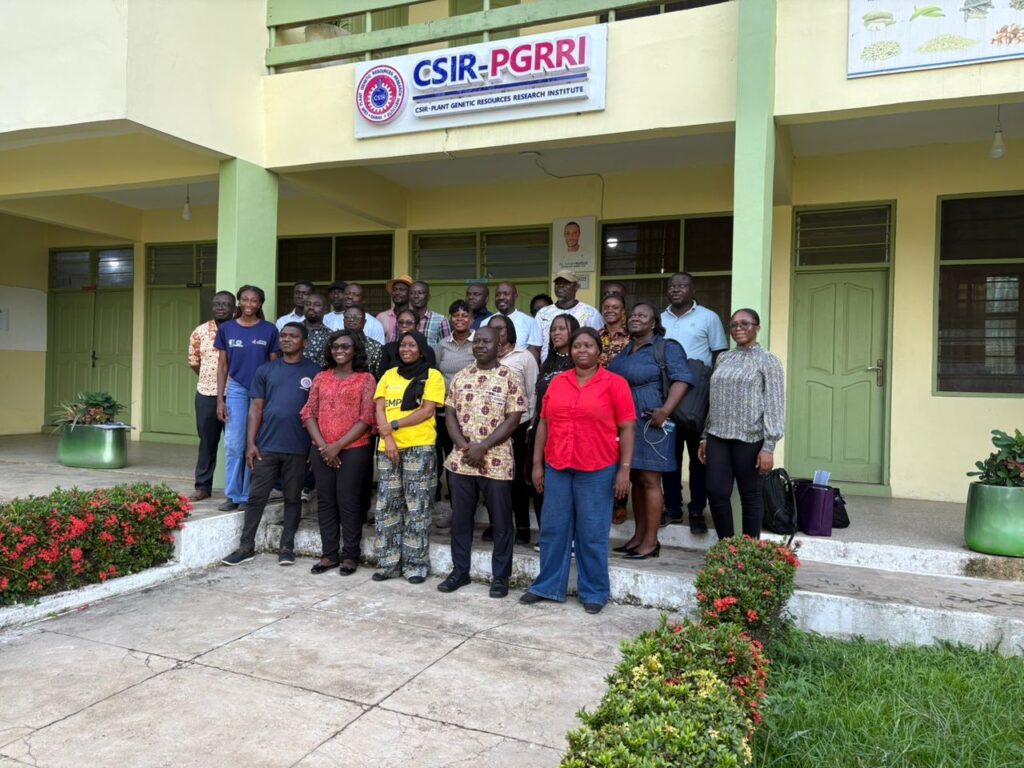
WUSC-EUMC and IUCN Capacity Building Workshop Trains Environmental Media Practitioners on Biodiversity, Forest Conservation, and Policy Accountability
By Esther Nuekie Annang
Bunso, Eastern Region, Ghana | June 23, 2026
A landmark capacity-building workshop for environmental journalists, reporters, and content creators concluded in Ghana on June 23, 2026, equipping media practitioners with the scientific knowledge, investigative tools, and policy frameworks needed to report on one of the country’s most pressing environmental challenges: the accelerating loss of biodiversity and forest genetic resources in the Guinean Forests of West Africa.
Organised by the World University Service of Canada (WUSC-EUMC) in collaboration with the International Union for Conservation of Nature (IUCN), the Council for Scientific and Industrial Research – Plant Genetic Resources Research Institute (CSIR-PGRRI), ABANTO, and World Agroforestry, with support from the Government of Canada, the workshop brought together journalists and content creators under the Biodiversity Media Learning Initiative. It was facilitated by Mr. Ben Sakyi of CSIR-PGRRI.
The workshop, spanning eight sessions of presentations, field visits, and practical assignments, covered topics from plant genetic resources and pollinator ecology to indigenous fruit tree enterprises and Ghana’s treaty obligations under international biodiversity law.
Ghana’s Forests on the Brink
Ghana sits within the Upper Guinean Forest, a global biodiversity hotspot, and is home to 906 native tree species. Yet the country’s forests are facing an existential crisis. According to data presented by Dr. Edmund Osei Owusu of CSIR-PGRRI, 146 of Ghana’s native tree species are endangered, and 38 have been classified as Critically Endangered, the highest extinction risk category.
Particularly alarming is the status of the Atewa landscape in the Eastern Region, where 58 endemic endangered species are found. These include commercially prized timber species such as African Rosewood (Pterocarpus erinaceus), Mahogany (Khaya anthotheca), Odum (Milicia excelsa), and Wawa (Triplochiton scleroxylon), trees that form the backbone of both Ghana’s timber industry and its rural forest ecosystems.
The drivers of this crisis are well-known: unsustainable logging, the expansion of agriculture and illegal mining (galamsey), infrastructure development, climate change-induced drought stress, and the loss of indigenous knowledge about forest species management.
“What gets measured gets managed,” said Dr. Daniel Ashie Kotey of CSIR-PGRRI during the workshop’s policy session, “and what journalists report on gets acted upon.”
Safeguarding the Genetic Blueprint
A central theme of the workshop was Ghana’s National Genebank, the country’s primary repository of plant genetic material, managed by CSIR-PGRRI at its Bunso facility in the Eastern Region.
Dr. Matilda Bissah and Dr. Rashied Tetteh presented the scope and significance of the genebank: it currently conserves over 4,000 orthodox accessions and 218 cryo accessions representing more than 80 plant species, ranging from cereals and legumes to root crops, vegetables, and threatened tree species. Since 2012, over 3,500 accessions have been distributed to farmers and researchers across Ghana.
Plant Genetic Resources (PGRs), the genetic material of plants with actual or potential value for food, agriculture, and ecological balance, were described as irreplaceable. “Once a genetic trait is lost, its potential value is gone forever,” Dr. Tetteh told participants. “PGRs are the bank of agriculture.”
The workshop also highlighted the National Tree Field Gene Bank Initiative, jointly established under the NbS Project. Two gene bank sites have been developed: a one-acre site in the Duase community in the Lake Bosomtwe landscape, and a two-acre site at the Bunso Eco Park Arboretum. The Bunso site hosts 12 priority indigenous tree species across 162 designed stands, including Odum, Mahogany, African Rosewood, Kusia, and Hyedua, serving as a living reservoir of planting materials for long-term landscape restoration.
Journalists on the field visit observed seed-sorting facilities where samples of velvet bean, pigeon pea, soybean, alligator pepper, and cinnamon bark are stored under controlled temperatures. They also toured the in-vitro genebank, where disease-free plantlets of cassava, yam, taro, pineapple, ginger, and plantain are grown in laboratory conditions for distribution to farmers.
A notable challenge disclosed during the visit: viability testing intervals for conserved seeds have been shortened from every five years to every three years due to the frequency of power outages, a stark reminder that cutting-edge conservation science is vulnerable to basic infrastructure failures.
The Invisible Workforce: Pollinators and Soil Organisms
Dr. Boamah Duku Emmanuel delivered what participants described as one of the workshop’s most eye-opening sessions, a deep dive into the economic and ecological value of pollinators, beneficial insects, and soil fungi to Ghana’s food systems.
As of 2005, pollination services contributed an estimated USD 208 billion annually to global agriculture. In Ghana alone, pollinators account for 11.1% of total national agricultural production, approximately USD 7 million per year, linking biodiversity conservation directly to economic survival.
Different crops depend on different pollinators. Ghana’s most iconic export crop, cocoa, relies uniquely on midges for pollination. Cashew, shea butter, coffee, oil palm, mango, and most vegetables depend heavily on bees, honeybees, stingless bees, and solitary bees. This crop-specific dependency means that managing and protecting pollinators is not a one-size-fits-all task, and pesticide use and habitat destruction affect different crops in different ways.
Below the soil surface, mycorrhizal fungi form symbiotic associations with plant roots, extending their reach into the soil to absorb water and minerals like phosphorus and nitrogen. Saprophytic fungi, meanwhile, decompose dead organic matter, releasing nutrients back into the soil as humus. Together, these organisms drive the nutrient cycling that sustains crop productivity without chemical fertilisers.
“Biodiversity conservation is not only about plants, animals, and wildlife above ground,” Dr. Emmanuel told the workshop. “Soil microorganisms like fungi are foundational to ecosystem functioning.”
Women, Wild Trees, and Green Enterprise
Session 7, delivered by Mr. Victor Nketia and Dr. Frederick Asamoah, reframed Ghana’s indigenous fruit trees as economic assets, not merely forest resources, and placed women at the heart of that economy.
An estimated 900,000 women are engaged in Ghana’s shea value chain alone, dominating the collection of shea nuts and the processing of shea butter. Species like Dawadawa (Parkia biglobosa), Baobab (Adansonia digitata), and African Star Apple (Chrysophyllum albidum) offer low-input, drought-tolerant income opportunities adapted to Ghana’s agro-ecological zones, making them ideal tools for climate adaptation.
Women are not merely labourers in these value chains: they are traditional knowledge holders who know tree locations, harvest times, and preparation methods. The session highlighted green enterprise opportunities along these value chains, from agroforestry businesses and nursery operations to processing, packaging, and eco-certified product branding for premium international markets.
“Indigenous fruit trees create multiple business pathways,” Mr. Nketia noted, “from nursery-raised seedlings to packaged products in export markets.”
The session also spotlighted ongoing CSIR-PGRRI projects, including the BOLDER Project, focused on collecting and conserving over 1,000 accessions of underutilised nutritious crops such as Amaranthus, Sesame, and Turkey berry, and a FAO-supported genetic improvement project for taro (Colocasia esculenta), which is broadening the genetic base of the crop for improved yield, drought, and disease tolerance.
Ghana’s Treaty Commitments: Promises on Paper?
Perhaps the most directly actionable session for journalists was Dr. Daniel Ashie Kotey’s presentation on tracking Ghana’s biodiversity-related government commitments.
Ghana has signed and ratified a range of international biodiversity and climate agreements: the Convention on Biological Diversity (CBD), the Nagoya Protocol on Access and Benefit-Sharing, the Paris Agreement (via Nationally Determined Contributions), and the UN Sustainable Development Goals, particularly SDG 15, which calls for halting biodiversity loss and restoring degraded ecosystems by 2030.
Among the most significant and underreported obligations is the Nagoya Protocol, a 2010 international agreement requiring countries to ensure that benefits derived from using genetic resources are shared fairly with the communities and nations that provide them. Ghana’s failure to robustly enforce this protocol opens the door to biopiracy: the unauthorised use of the country’s plant genetic resources by external commercial or research actors.
“Biopiracy, the unauthorised use of Ghana’s plant genetic resources is an investigative story waiting to be told,” Dr. Kotey told participants. “The Nagoya Protocol is the legal shield against it.”
Journalists were equipped with practical tools to monitor government implementation, including Ghana’s Environmental Protection Authority (EPA) national reports, the CBD Clearing-House Mechanism (chm.cbd.int), Global Biodiversity Information Facility (gbif.org), Global Forest Watch (globalforestwatch.org), and the ABS Clearing-House (absch.cbd.int) for tracking Nagoya Protocol compliance.
A specific measurable target journalists were urged to track: Ghana’s commitment to protect 30% of its land and sea by 2030, the so-called “30×30” target under the Kunming-Montreal Global Biodiversity Framework.
Journalism as Conservation
The overarching message threading through all eight sessions was the indispensable role of media in translating conservation science and policy commitments into public awareness, accountability, and action.
Presenters repeatedly stressed that Ghana’s biodiversity crisis, from the critically endangered trees of Atewa to the declining pollinators of its cocoa farms, will not be reversed by science alone. Community engagement, policy enforcement, and sustained public pressure all depend on informed, skilled environmental journalism.
Rusmond Anyinah of WUSC and Mrs. Dorcas Owusuaa Agyei of IUCN opened the workshop with a call to “Unite for Nature,” framing media practitioners as essential partners alongside communities and institutions.
The NbS Project, under which the workshop was organised, targets two landscapes in Ghana: the Lake Bosomtwe landscape (covering the Bosomtwe and Bosome Freho districts) and the Wassa Amenfi landscape (covering the Amenfi West, East, and Central districts). The project is part of a broader initiative covering Côte d’Ivoire, Ghana, and Guinea, with the ultimate aim of enhancing gender-inclusive, community-led climate change adaptation in the Guinean forests.
Participants left the workshop with story assignments: investigative pieces on biopiracy, data stories tracking Ghana’s 30×30 conservation targets, explainers decoding NDCs for farmers and fishers, and policy briefs assessing the NBSAP’s implementation on the ground.
“Ghana has strong environmental policies and rich biodiversity,” the workshop report concluded. “But policies don’t protect forests; enforcement, funding, and public pressure do. That’s where journalism, reporting, and content creation comes in.”
WUSC-EUMC, CECI, IUCN, the Government of Canada, CSIR-PGRRI, ABANTO, and World Agroforestry supported the capacity-building workshop.
Participants may access germplasm from CSIR-PGRRI through direct contact with the Bunso office, through Agricultural Extension Agents (AEAs) from the Ministry of Food and Agriculture (MOFA), or via the institute’s website: www.pgrri.csir.org.gh